Cat and Shanmao's blog
Tuesday, December 26, 2006
Catalan's version of St. Valentine's day: St. George's day
Catalans are very devoted to St. George and trace him back to Tarragona, Spain in the 8th century. His name was Jordi. This has been translated to George in English.
St. George is the patron saint of Catalonia. Roses, one of the symbols of St. George, adorn the Palace of Catalan Music proclaiming that this is most definitely a Catalan building and cultural center.
Instead of St. Valentine's day, in Catalonia the tradition is on April 23, St. George's day, for a boy to give a girl roses and for her to give him a book! Quite a literary tradition. Interestingly April 23 is the birthdate and deathdate of Shakespeare and the birthdate of Cervantes (although for these famous authors these dates have to be qualified by an indication of which calendar - Julian or Gregorian - was used to label the date).
Another interesting anecdote is that a musician who I've become interested in lately is Jordi Savall. I didn't realize that his first name was essentially 'George' and that this name was significant to Catalonia (he's from Catalonia and based in Barcelona). Interestingly, his wife is named "Montserrat Figueres". Montserrat is a famous mountain southwest of Barcelona and Figueres is a historic town northeast of Barcelona (and home to the Dali museum).
Sunday, December 17, 2006
Zanpanzar
When we were visiting Spain we first flew into Girona, Spain, a charming town 100 km from Barcelona.
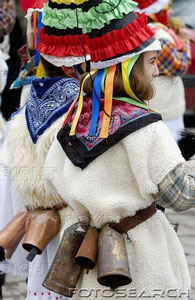
Our evening meal for the night we stayed there was at Zanpanzar. I saw some cute figurines, perhaps carved out of wood, that depicted a druid or hermit like character with some colourful costume in a dramatic pose. I asked if this person was Zanpanzar, the name of the restaurant. The server at this tapas bar said yes. I assumed that this was some mythic or historical person named Zanpanzar. My imagination went wild with the thought of a Gandalf like character travelling the Basque country, magically being transported about, communing with nature, and providing aid and wisdom when needed.
When I got home I google'd Zanpanzar but didn't have much luck at first. After restricting my search to English I turned up this tidbit:
The fertility ritual Zanpanzar is actually a walk, not a dance. In what is almost a procession, men from two towns walk to each other's town and have dinner. This ritual occurs near the time of Mardi Gras (Lent). Huge bells, worn on the men's backs, are sounded, the idea being to wake up the earth. Each man carries a horse tail on a stick with which he caresses the earth (the horse being a fertility symbol). They wear sheepskins, white slips adorned with lace, and cone-shaped hats with rooster feathers at the top.
So Zanpanzar is not a person but a dance and apparently also can be used to name or describe the person who performs the dance, i.e. the Zanpanzar wore a very colourful costume.
Links
- Gui and Matthew's Home Page
- Gui and Matthew's Guestbook
- Jean's blog
- Letters from Thailand
- The weather in San Mateo
- Peninsula Library System
- San Francisco Public Library
- San Mateo County Transit
- Caltrain
Archives
current
01/01/2004 - 02/01/2004
02/01/2004 - 03/01/2004
03/01/2004 - 04/01/2004
06/01/2004 - 07/01/2004
07/01/2004 - 08/01/2004
10/01/2004 - 11/01/2004
11/01/2004 - 12/01/2004
12/01/2004 - 01/01/2005
01/01/2005 - 02/01/2005
02/01/2005 - 03/01/2005
04/01/2005 - 05/01/2005
05/01/2005 - 06/01/2005
02/01/2006 - 03/01/2006
03/01/2006 - 04/01/2006
06/01/2006 - 07/01/2006
10/01/2006 - 11/01/2006
12/01/2006 - 01/01/2007
01/01/2007 - 02/01/2007
02/01/2007 - 03/01/2007
03/01/2007 - 04/01/2007
04/01/2007 - 05/01/2007
06/01/2007 - 07/01/2007
07/01/2007 - 08/01/2007

