Cat and Shanmao's blog
Sunday, November 09, 2008
Book Review: In Defense of Food by Michael Pollan
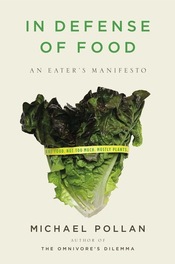 Michael Pollan's bestselling book The Omnivore's Dilemna took us on a journey through the US (and Canadian) food systems. Highly influential, I've seen the book numerous times on the bus and subway, and have had several conversations about it. Unfortunately, for those who wanted some advice they could take home for day to day living there wasn't much there. Never fear, eager to help out his countless readers Pollan has prepared the extremely interesting and practical In Defense of Food.
The book is divided into three parts - a jeremiad against nutrition science, an examination of the health effects of the diet nutrition science has deliver to us, and then finally a blueprint for deciding how to eat.
First off, the title needs some explanation. Pollan differentiates between food and food products. Food is what your grandmother or great grandmother would recognize. Food products are what 80% of the supermarket is stocked with. The first paragraph in the book (and which is cleverly printed on the band wrapping the lettuce on the front cover photo) summarizes everything that follows:
"Eat food. Not too much. Mostly plants."
Simple. Read the rest of the book to find out how complicated and unhealthy our eating lifestyle has become, why Pollan came to this conclusion, and his practical advice for making day to day decisions.
Nutrition science - the food pyramid, studies on the effects of trans fat, debates about the merits and perils of coffee and alcohol, the famous sample group of nurses that form the basis of many medical conclusions. He covers this area well and it is an eye opener. Although science and technology have given us many wonderful things we have to remember that scientists are humans prone to fallibility, bias, manipulation, and the necessity of making a living.
One of the fascinating failings of nutrition science and government and commerical interests that promote its findings is the inability to recommend that we eat less or at least limit the amount of food we eat. We are always told that eating food A or food B solves health problem A or B. What we're seldom told is that we should consider eating less of food A, B and all the other foods in our diet. Eating less is simply a commercially unpalatable option and industry and their government representatives have made sure that no such pronouncements can be made when recommending foods and nutrients. Many health problems could be solved by simply eating less food.
I've always found reading newspaper articles about nutrition and medicine interesting. No sooner is one conclusion published on the second page then a few months later a contradictory news story published. Coffee is good for you. Coffee is bad for you. Carbs are good. Carbs are bad. Fat is good. Fat is bad. Wine is good. Wine is bad. On occasion, I've paid attention to the food pyramid but about five minutes after reviewing it I really can't remember what's in it. I tend to read the health benefits advertised on supermarkets goods - no transfat, N% of the daily recommended of vitamin X, etc. This whole system is so confusing.
Well, after you read Pollan's book you'll realize just how scary the situation is. Nutrition science is basically in the business of isolating nutrients in foods and finding ways of manufacturing new vehicles to profitably deliver those nutrientsto your body. The goal is not to improve your health (just as the current goal of GMOs is not to improve the taste or health of foods - by creating a incredibly tasty bacon double cheeseburger that's actually helps your heart out and cleans your arteries - but instead simply to maximize the profitably of pesticide use)
Pollan lays out a list of principles to eat by which I've transcribed with minimal comments here:
- Eat food
- Avoid food products containing ingredients that are a) unfamiliar, b) unpronouncable , c) more than five in number or that include d) high-fructose corn syrup
- Avoid food products that make health claims
- Shop the peripheries of the supermarket and stay out of the middle
- Get out of the supermarket whenever possible
- Eat mostly plants, especially leaves
- You are what what you eats too
- If you have the space, buy a freezer
- Eat well-grown food from healthy soils
- Eat wild foods when you can
- Be the kind of person who eats supplements
- Eat more like the French or the Italians or Japanese or the Indians or the Greeks (or I would add the Ukrainian diet, in other words, pick traditional diets and eat them instead of the non-traditional manufactured US diet)
- Regard non-traditional foods with skepticism
- Don't look for the magic bullet in the traditional diet
- Have a glass of wine with dinner
- Pay more, eat less
- Eat meals
- Do all your eating at a table
- Don't get your fuel from the same place your car does
- Try not to eat alone
- Consult your gut
- Eat slowly
- Cook and, if you can, plant a garden
Links
- Gui and Matthew's Home Page
- Gui and Matthew's Guestbook
- Jean's blog
- Letters from Thailand
- The weather in San Mateo
- Peninsula Library System
- San Francisco Public Library
- San Mateo County Transit
- Caltrain
Archives
current
01/01/2004 - 02/01/2004
02/01/2004 - 03/01/2004
03/01/2004 - 04/01/2004
06/01/2004 - 07/01/2004
07/01/2004 - 08/01/2004
10/01/2004 - 11/01/2004
11/01/2004 - 12/01/2004
12/01/2004 - 01/01/2005
01/01/2005 - 02/01/2005
02/01/2005 - 03/01/2005
04/01/2005 - 05/01/2005
05/01/2005 - 06/01/2005
02/01/2006 - 03/01/2006
03/01/2006 - 04/01/2006
06/01/2006 - 07/01/2006
10/01/2006 - 11/01/2006
12/01/2006 - 01/01/2007
01/01/2007 - 02/01/2007
02/01/2007 - 03/01/2007
03/01/2007 - 04/01/2007
04/01/2007 - 05/01/2007
06/01/2007 - 07/01/2007
07/01/2007 - 08/01/2007
08/01/2007 - 09/01/2007
12/01/2007 - 01/01/2008
02/01/2008 - 03/01/2008
04/01/2008 - 05/01/2008
05/01/2008 - 06/01/2008
09/01/2008 - 10/01/2008
11/01/2008 - 12/01/2008

